

Clinical & Occupational
Health Reference
Clinical & Occupational Health Reference
Instrumented Biomechanical Design
DBx Knives — Hand, Wrist & Arm Protection
Traditional culinary knife and handle design presents a fundamental ergonomic paradox — a 50x physics problem with direct biological consequences.
Current designs force the user to funnel high forces through small handle contact areas.
These designs require the human hand to act as a high-pressure vise to stabilize it.
DBx asymmetrical handle and blade geometry resolves this paradox by mirroring the natural human grasp.
Clamping and cutting forces are distributed throughout the hand — reducing average peak grip pressures to relatively safe levels.
This moves culinary ergonomics from anecdotal design into quantitative, biomechanically supported knife design.
DBx Knives are designed to protect the neuro-vascular and musculoskeletal systems of the hand, wrist and arm.
Passive fit geometry eliminates the active stabilization and high pressure demands of traditional handle designs — the root cause of cumulative hand injury.
Instrumented testing documents a 98% reduction in average peak grip pressure compared to traditional culinary knife designs.
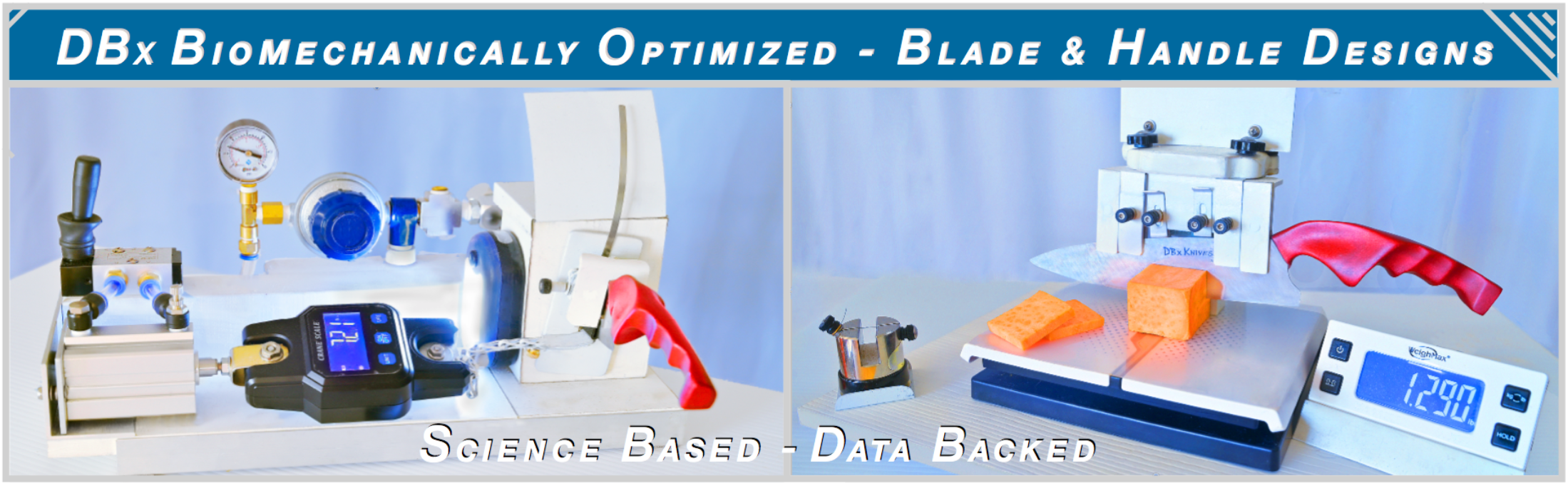
Every claim is backed by instrumented ABx performance testing on high density foods under real-world cutting conditions.
Independent peer-reviewed research from the meat processing industry confirms the exponential relationship between grip force reduction and injury risk — consistent with our testing conclusions.

The Biological Evidence
High grip pressures generated by traditional culinary knife handles do not remain at the surface of the hand.
Blood Flow Restriction Cause . . .
Mechanism & Clinical Consequence
The Biological Evidence
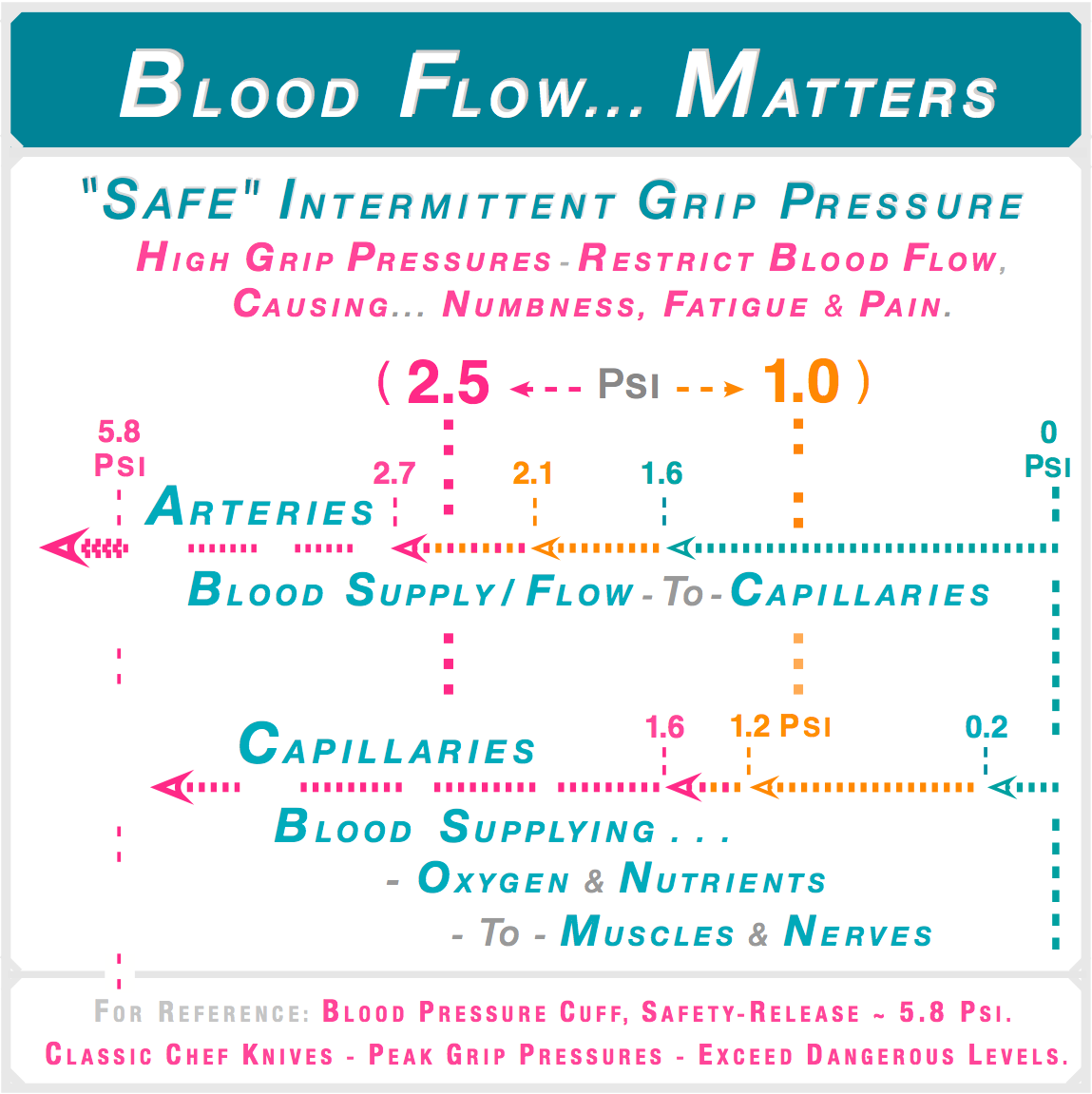
They Penetrate the neuro-vascular and musculoskeletal systems: restricting blood flow, compressing nerve pathways & accumulating tissue damage with every cutting session.
Relatively safe levels of intermittent biomechanical grip grasp pressures are in the 1.0 to 2.5 PSI range .
Sustained pressure levels, within & above this range yield significant reductions of blood flow supplied oxygen & nutrient levels.
Affected subsystems suffer reduced levels of: strength, survival, and daily recovery rates of tissues in the hand, wrist and arm.
Cumulative trauma from sustained high grip pressures leads to progressive and debilitating hand conditions.
Traditional culinary knife designs generate peak grip pressures during food preparation that exceed these thresholds by a significant margin.
Nerve Compression — Safety Signal . . .
Loss & Permanent Damage Thresholds
Traditional culinary knife grip pressures routinely exceed even this reference level with every cutting session.
The Biological Evidence
Concentrated Force Transfer — The Root Cause Of Cumulative Culinary Hand Injury
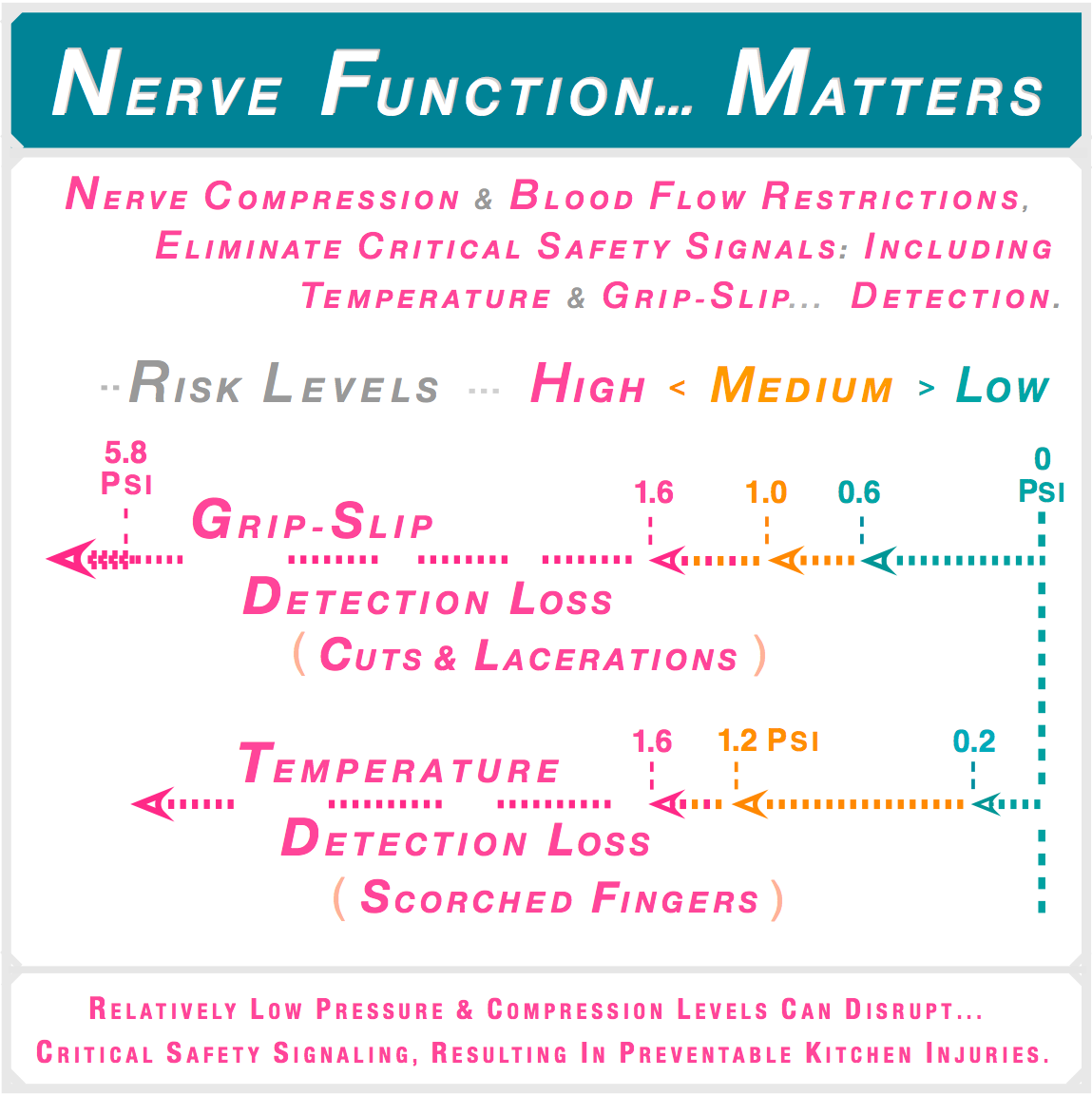
Nerve compression at relatively low pressure levels eliminates critical safety signals including grip-slip detection and temperature sensing.
Loss of these signals during knife use
produces preventable kitchen injuries ...
— cuts, lacerations, and scorched fingers
— that are incorrectly attributed to user error rather than handle design failure.
Pressure levels in the 0.2 to 1.6 PSI range and above interrupt sensory perception.
Published research documents peripheral nerve jeopardy beginning at 0.8 to 1.0 PSI.
Standard blood pressure instruments operate at pressures up to 5.8 PSI — five times that threshold.
The Biological Evidence
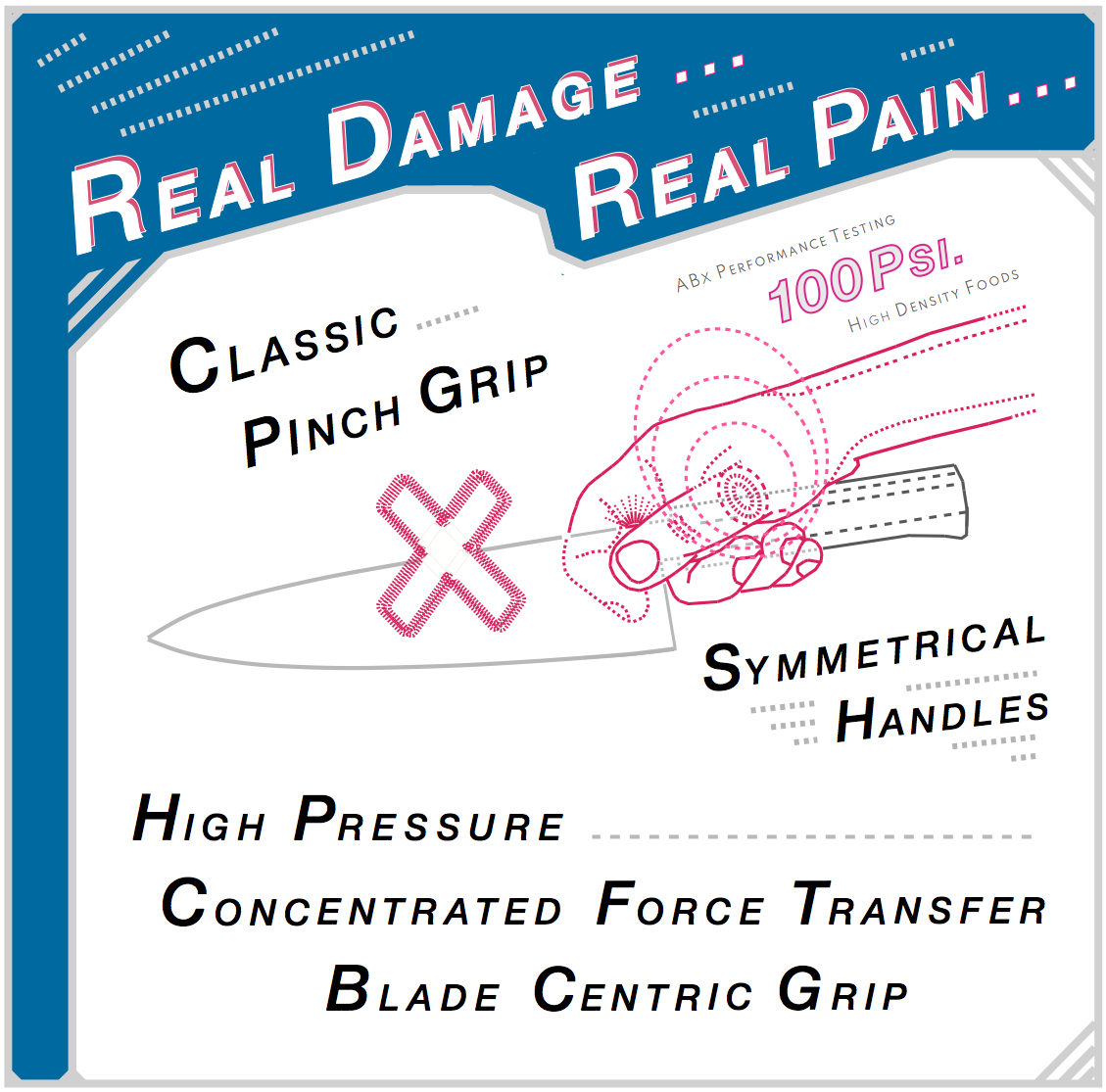
The traditional professional culinary Pinch Grip is a friction-based grasp, which concentrates high levels of vascular compression in the thumb & index finger.
Biomechanically these pressures reduce blood flow to the soft tissues throughout the hand - limiting oxygen and nutrient delivery precisely where highest biological demand exists.
The compound effect is… accelerated tissue damage and reduced daily recovery rates especially in the thumb & fingers sustaining the greatest mechanical load.
The cumulative tissue damage is often referred to as scar tissue - the precursors to tendonitis and arthritis.
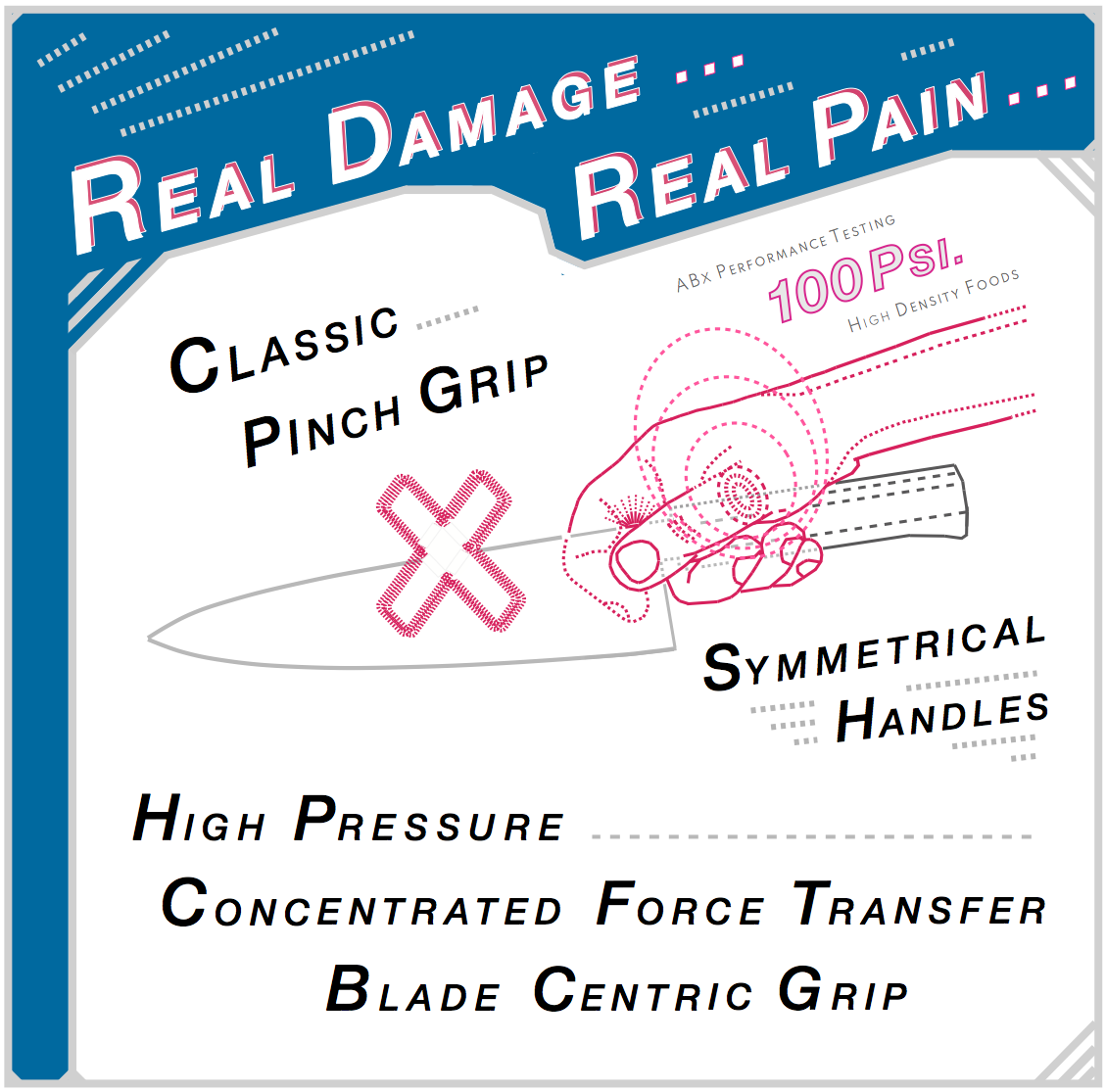
A standard blade-centric pinch grip, used in conjunction with traditional handles, funnels down forces through small contact zones.
Average peak grip contact pressure levels exceed biomechanically safe pressure levels for medium and high density food prep.
Handle design geometry is the root cause of cumulative trauma producing debilitating injuries in culinary environments.
This is a 50x physics problem, which is not impossible to solve.
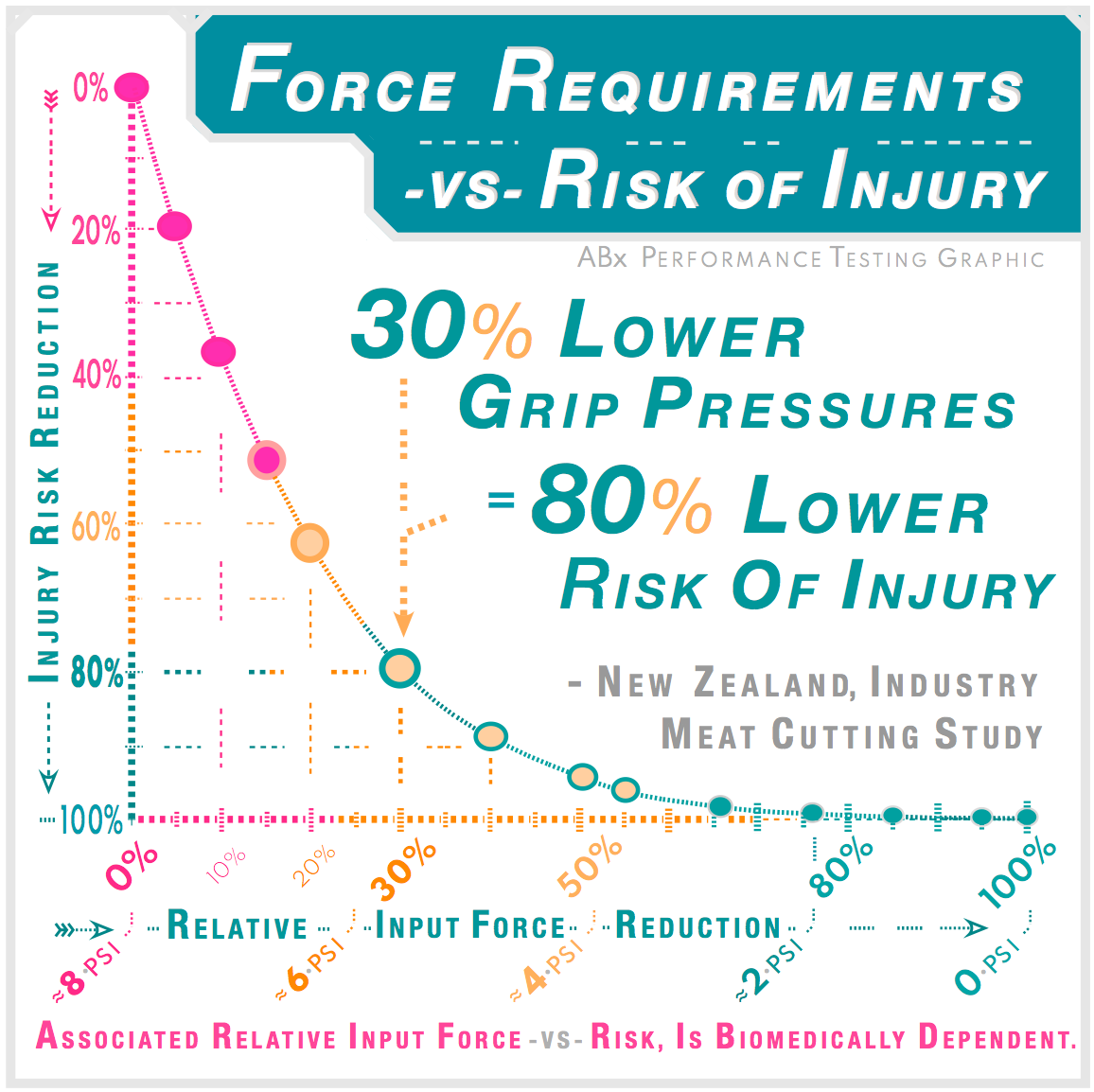
The relationship between grip force and injury risk is exponential, not linear.
A 30% (0.3x) reduction in grip forces reduces risk of deep tissue damage along with repetitive stress & strain injuries by 80%.
This correlation reflects Independent peer-reviewed research performed for the New Zealand meat cutting industry.
DBx Knife designs yield a 50x reduction in average peak grip grasp when compared to traditional chef knife designs.
Grip grasp forces are reduced to relatively safe levels even when cutting most high density foods.
“Associated relative input force vs risk is biomedically dependent.”
ABx Performance Testing
The Biological Evidence
Exponential Injury Risk Reduction
New Zealand Meat Industry Research Confirmed
Instrumented Biomechanical Engineering
The DBx Design Solution
Instrumented Biomechanical Design
The DBx Design Solution
It is the cumulative outcome of resolving every mechanical failure point in traditional handle geometry simultaneously: contact area - force distribution - grip orientation - and - blade-to-hand indexing.
The 98% reduction in average peak grip pressure documented by ABx performance testing . . .
- is not the result of a single design change.
Pressure = Force ÷ Area — The Physics Principle Classic Handle Design Ignores
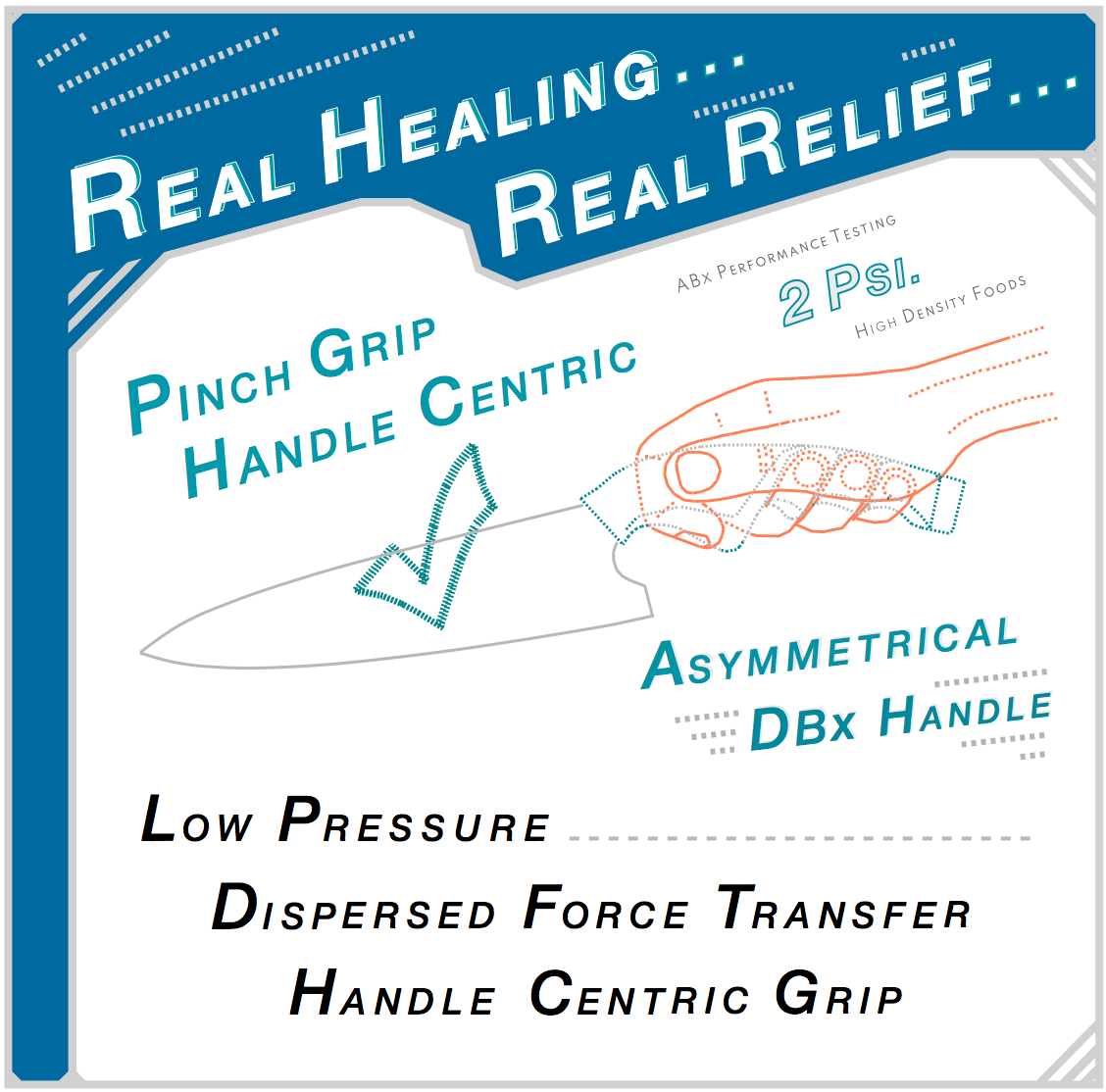
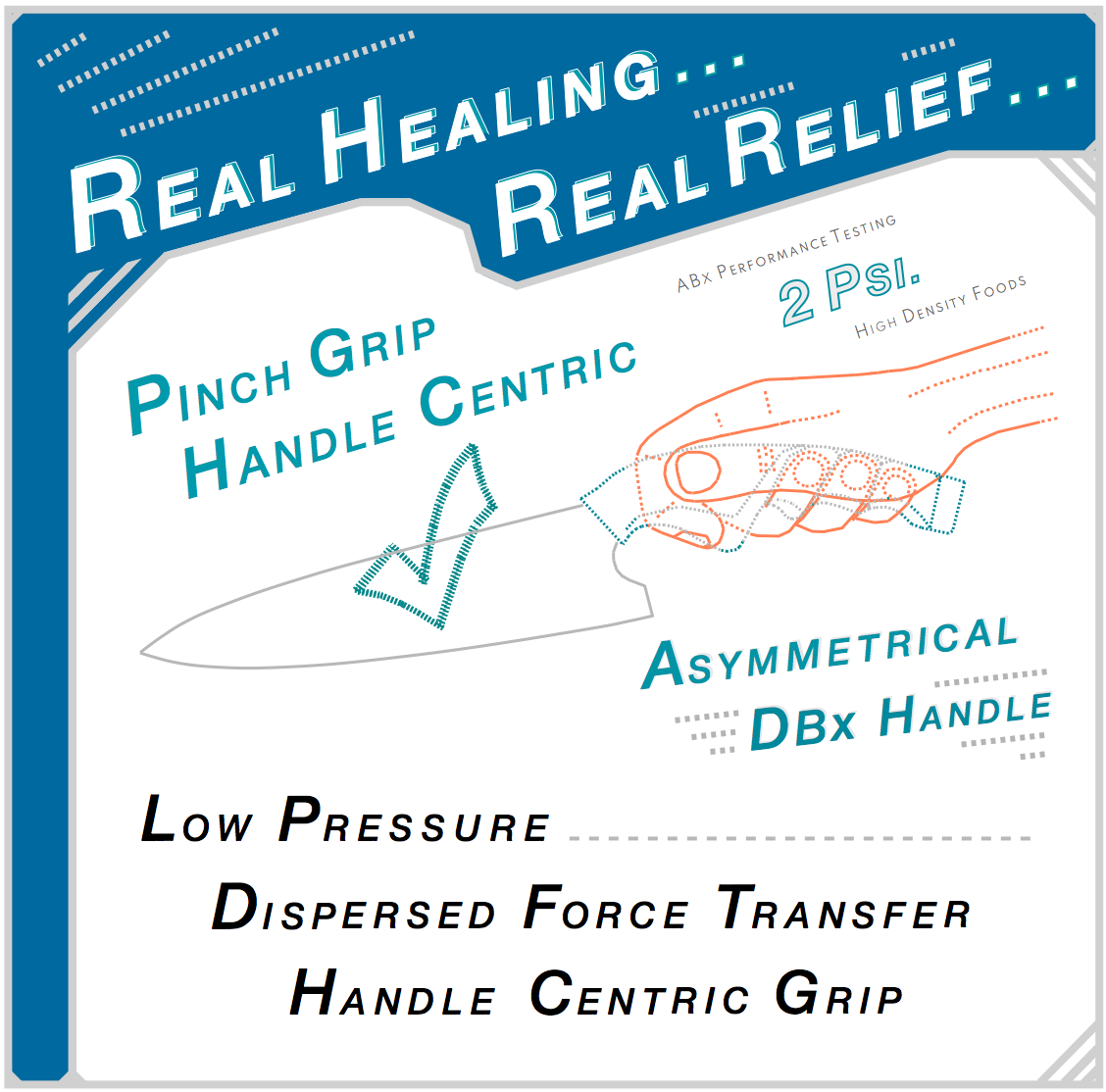
Asymmetrical DBx handle geometry produces a natural handle-centric pinch grip . . .
dispersing cutting & stabilization forces across 31 of the 33 possible grip contact surfaces in the hand.
This force distribution reduces average peak grip pressure by 98% and clamping forces by more than 80% . . .
Reducing average peak grip pressure to under 2 PSI in high density food cut testing.
ABx Performance Testing.
The DBx Design Solution
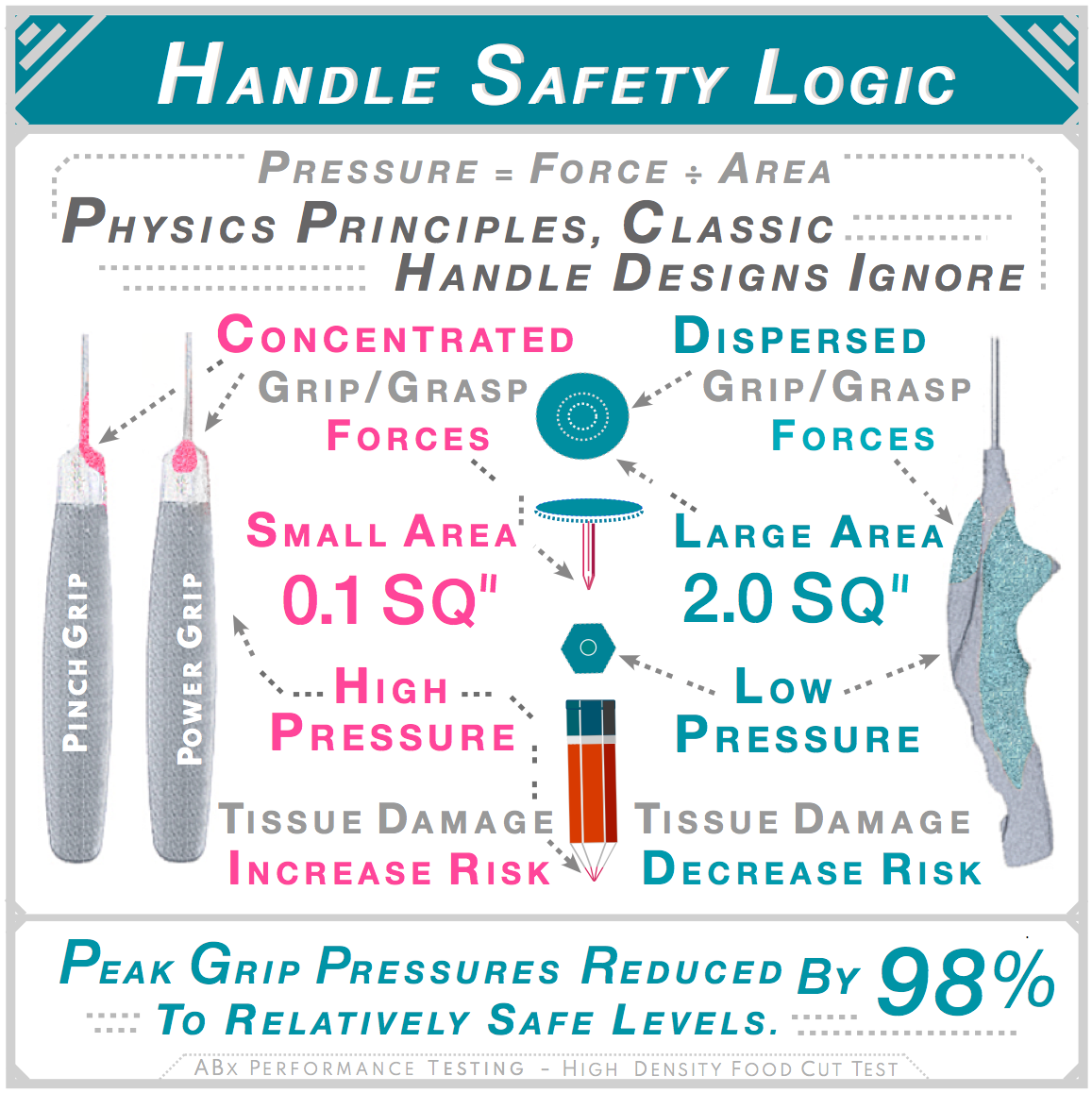
Pressure equals . . .
force divided by area.
Traditional handle designs ignore this principle ...
Often concentrating grip & grasp forces through a 0.1 square inch contact zone, producing tissue damage and exponentially increasing injury risk.
DBx handle geometry applies the same physics principle in reverse ...
dispersing identical cutting forces across a 2.0 square inch contact zone, reducing peak pressures to relatively safe levels.
ABx Performance Testing . . .
High Density Food Cut Test.
The DBx Design Solution
Sized To Fit — Eliminating Compensatory
Clamping Force Entirely

The DBx Design Solution
Standard knife handles are manufactured in one or two universal sizes . . . requiring the hand to compensate for the size mismatch through active clamping force.
Classic handle Geometry reduces Grip stability by 50% to 80%, forcing the hand to generate 2x to 4x more clamping force to control blade Trajectory.
These high mechanical clamping forces contribute to elevated levels of fatigue, numbness and pain during extended knife use in both healthy and compromised hand anatomy.
DBx sized-to-fit handle geometry eliminates compensatory clamping force entirely . . . retaining 100% of available grip power without active stabilization demand. ABx Performance Testing.
The DBx Design Solution
Four Cooperative Groups — Coordinated To Amplify Grip Strength 4x
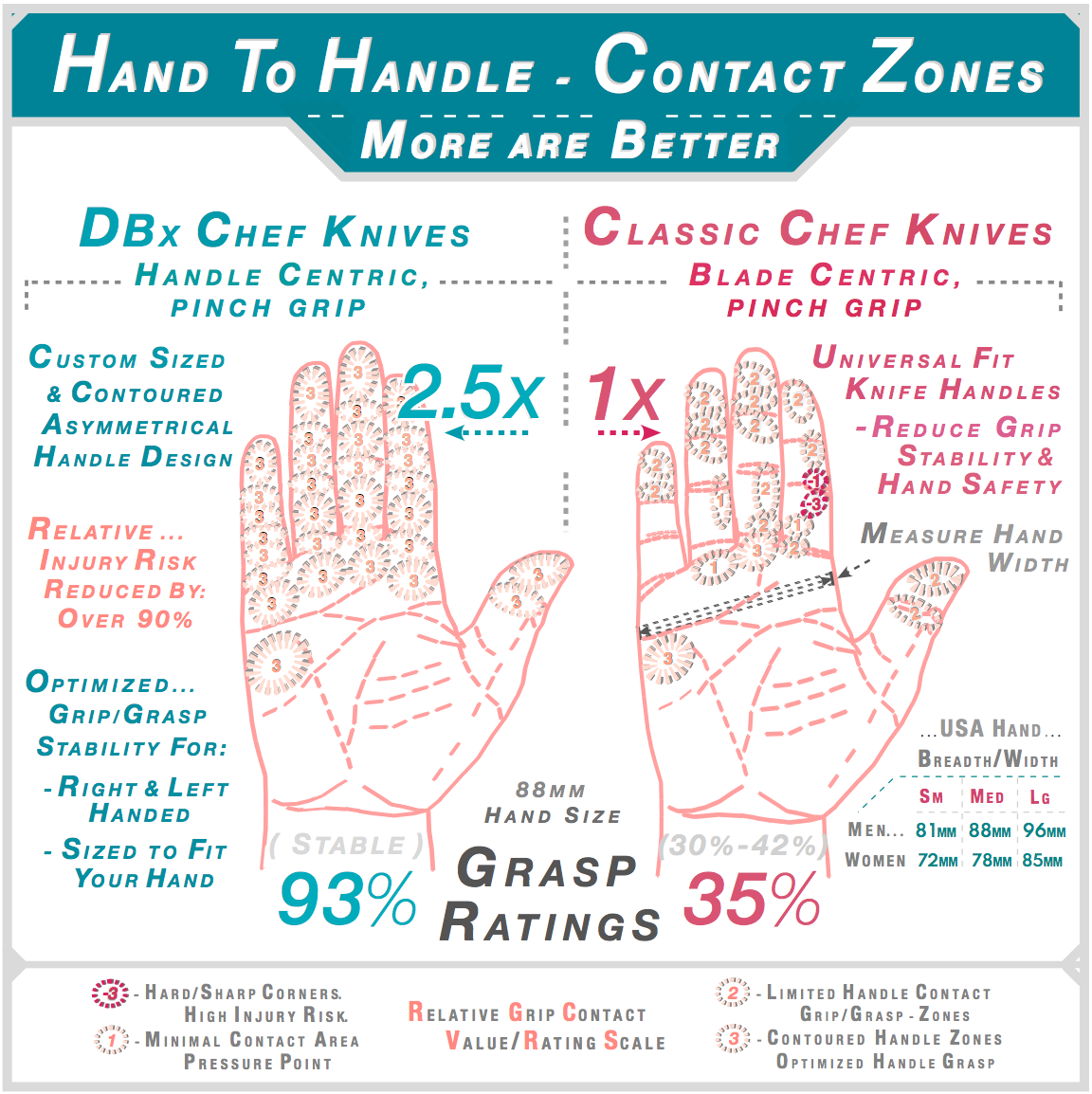
DBx custom sized and contoured asymmetrical handle designs increase effective hand to handle engagement . . . producing a 93% grasp stability rating against 35% for universal fit handles.
Contact zone coverage determines grip stability, cutting force transfer efficiency, and injury risk.
Classic chef knife handles yield fewer effective contact zones . . . limiting our opportunities to transfer clamping and cutting force, while compounding the risk of injury.
Hand width measurement determines handle size . . . matching contact zone geometry to individual hand anatomy is the foundation of DBx handle design.
The DBx Design Solution
2.00 Square Inch Contact Area — A 20x Increase
Over Classic Handle Designs
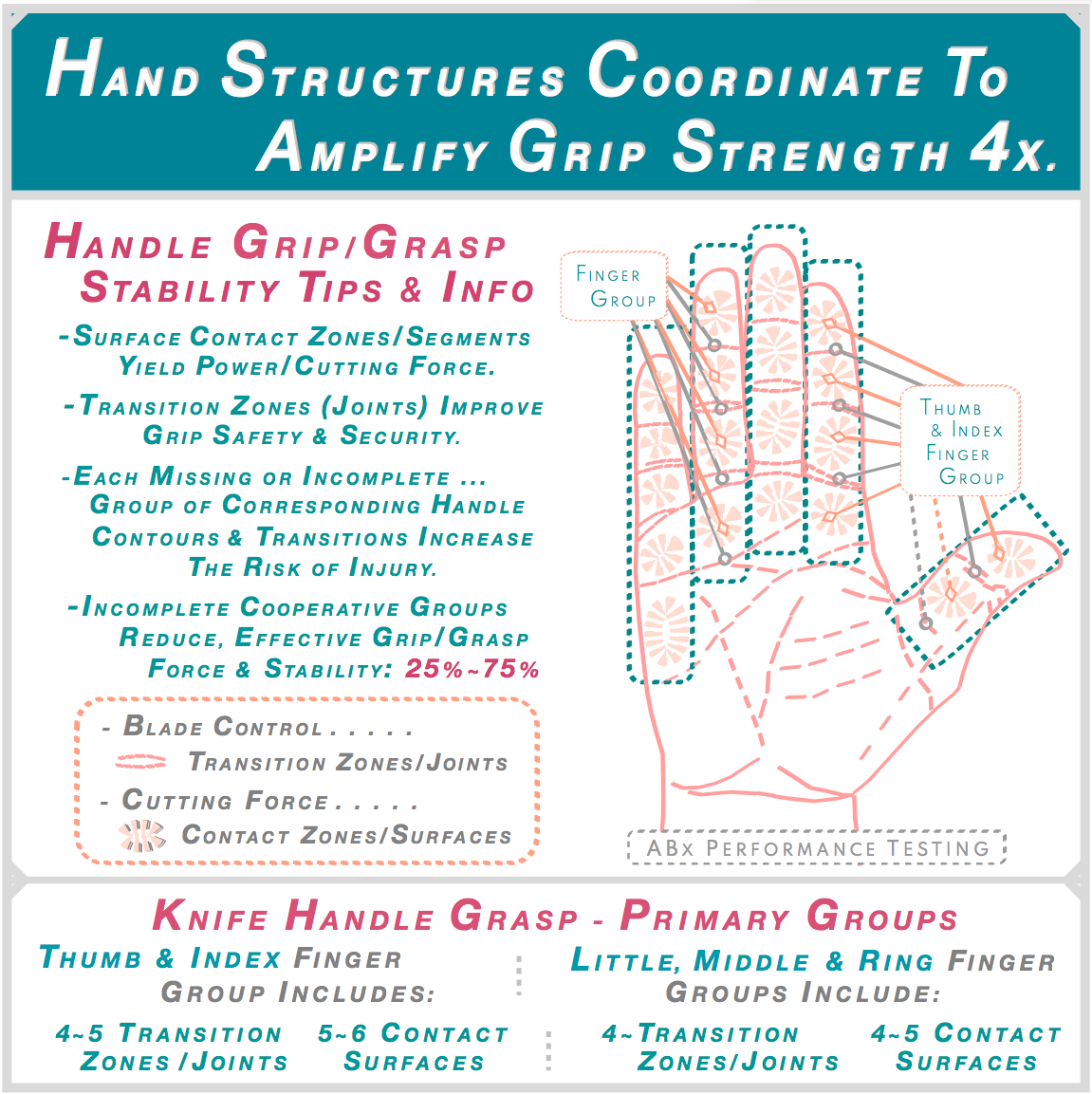
The hand Accumulates power through four primary cooperative groups . . . the thumb and index finger group, along with the little, middle and ring finger groups.
Each group contributes power transferred through contact surfaces that generate cutting force and Grip/grasp stability.
Hand joints paired with handle transition zones provide blade control and grip security.
When all cooperative groups engage a correctly fitted handle simultaneously, hand structures coordinate to amplify effective grip strength by 4x.
In a structurally damaged hand, incomplete cooperative groups reduce effective grip force and stability by 25% to 75% depending on which groups are compromised.
Custom fitted DBx handle geometry is engineered to maximize the contribution of every intact and partially functional cooperative group remaining . . . accumulating grip strength that the damaged hand cannot generate without geometrically corrected handles.
Each missing or incomplete group of corresponding handle contours and transitions increases injury risk . . . custom geometry closes that gap to the fullest extent the remaining anatomy allows.
93% Grasp Stability Rating — Contact Zone Coverage Determines Injury Risk

DBx asymmetrical handle geometry provides 2.00 square inches of effective pinch grip surface area . . .
a 20x increase over the 0.10 square inch average effective contact area of classic chef knife designs.
Right & left hand specific handles available from 72mm to 96mm.
Handle size matched to individual hand geometry eliminates compensatory clamping force . . .
the primary driver of cumulative pressure injury.
Instrumented Testing — 100 PSI vs 2.0 PSI
— 98% Reduction Into Safe Range
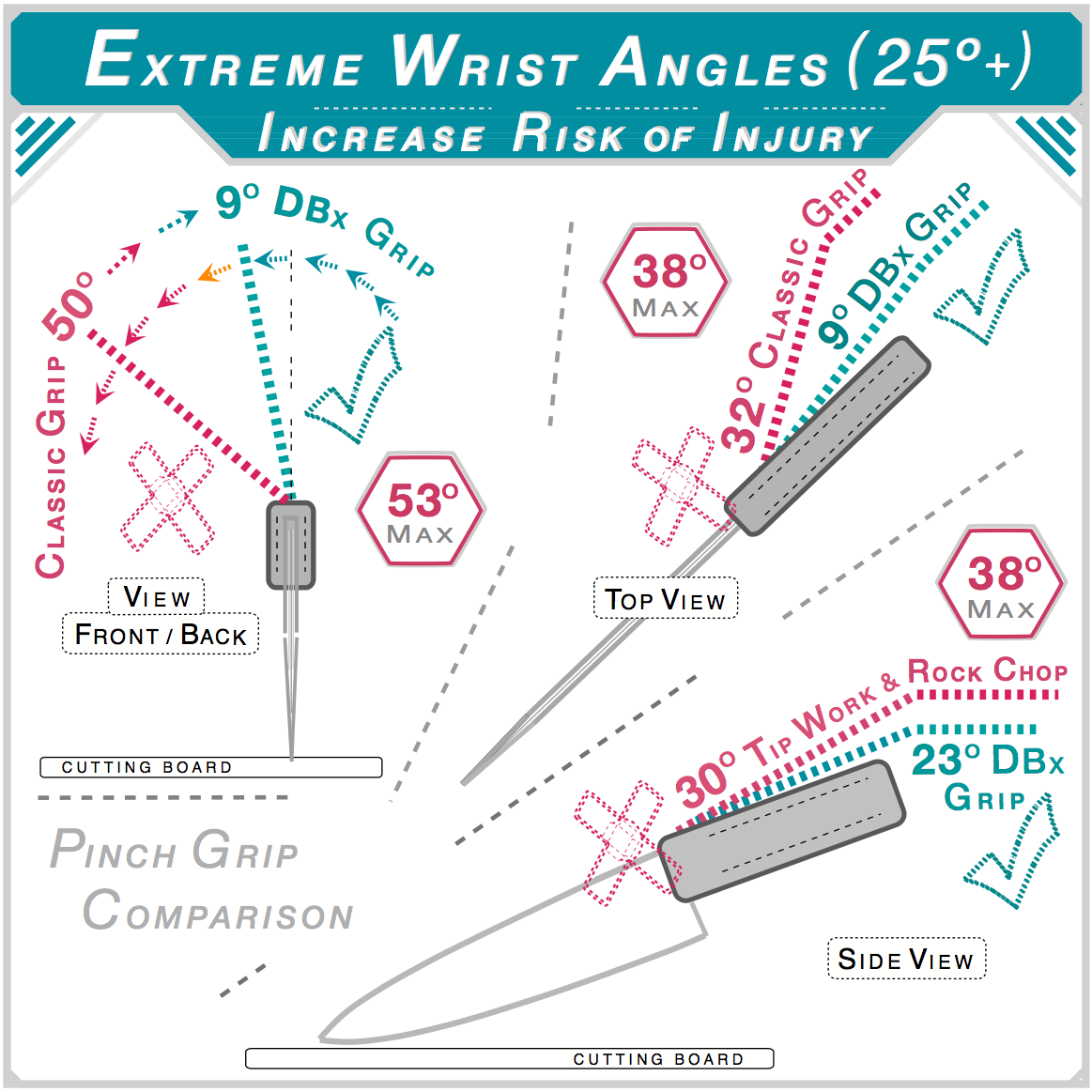
Wrist angles above 25 degrees are a documented risk factor for cumulative nerve and tendon injury.
Classic blade-centric pinch grip requires . . .
- Combined, arm + wrist rotational deviation
of (50 out of a maximum 53 degrees)
- Blade to forearm arm alignment . . .
(32 out of a maximum 38 degrees)
- Tip work & rock chopping . . .
(30 out of a maximum 38 degrees)
These angles place high sustained loads on the carpal tunnel, median nerve, and flexor tendon systems throughout every cutting session.
DBx handle-centric pinch grip knife designs reduce maximum wrist angle deviation into relatively safe biomechanically zones across all standard culinary cutting tasks.
The reduction in wrist angle deviation is a direct consequence of handle geometry correction — not technique modification.
The DBx Design Solution
Wrist Angle Reduction — From Dangerous
Deviation To Relatively Safe Zones

Instrumented ABx performance testing on high density foods . . .
documents average peak grip pressures of: 100 PSI for classic chef knife designs against 2.0 PSI for DBx custom chef knives . . .
a 98% reduction into a relatively safe biomechanical grip pressure range of 1.0 to 2.5 PSI.
DBx fitted handle geometry reduces culinary grip pressure into that relatively safe range for most high density foods.
the first documented science based, data backed test result in the history of knife design.
The DBx Design Solution
50x Performance Advantage — Permanent Handle Ergonomics vs Temporary Sharpness
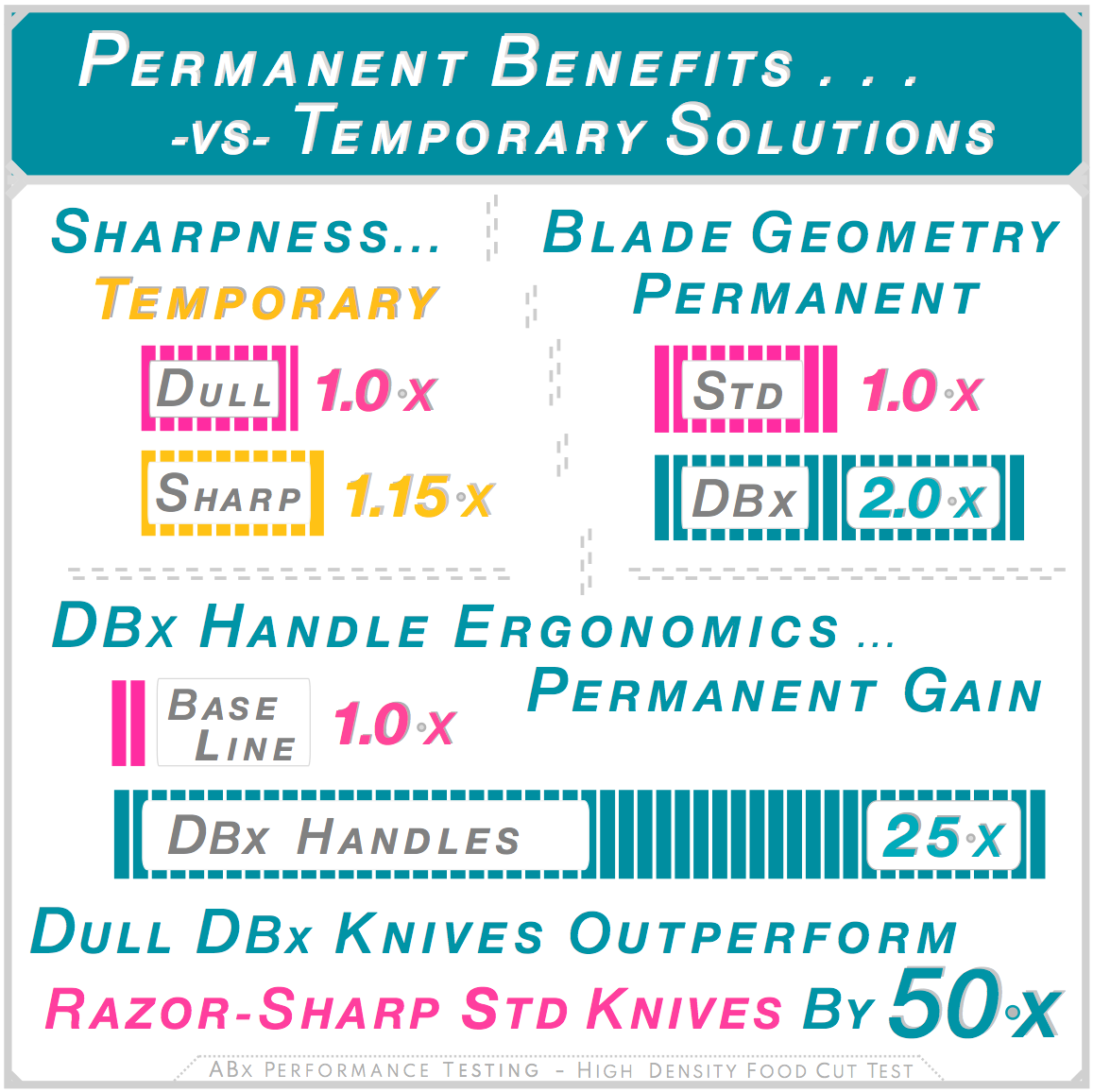
Sharpness provides a 1.15x temporary cutting performance advantage that degrades with use and requires ongoing maintenance.
DBx blade geometry provides a permanent 2.0x cutting performance advantage.
DBx handle ergonomics provide a permanent 25x grip performance advantage.
The combined result — a dull DBx knife outperforms a razor-sharp standard knife by 50x.
ABx Performance Testing
— High Density Food Cut Test.
The DBx Design Solution
These are not comfort claims. Every performance advantage documented here - is A direct mechanical Consequence of resolving - the fundamental physics problems
that traditional handle design, has ignored for generations.
Custom Biomechanical Accommodation
Designed For Your Hand.
Exactly As It Is.
Custom Accommodation
Handle optimization for altered Hand Anatomy . . .
Standard ergonomic knife design assumes - an uninjured hand, with a naturally symmetrical grasp — a grasp geometry, that human anatomical Evolution has not produced.
DBx custom accommodations start from a different premise . . .
— that the anatomically asymmetrical hand being fitted is the hand that matters, regardless of its history.
Every contour, every indexing correction, every force balance adjustment is engineered to the specific anatomy in front of us.
Custom Balance . . .
Handle Indexing for
altered Hand Anatomy
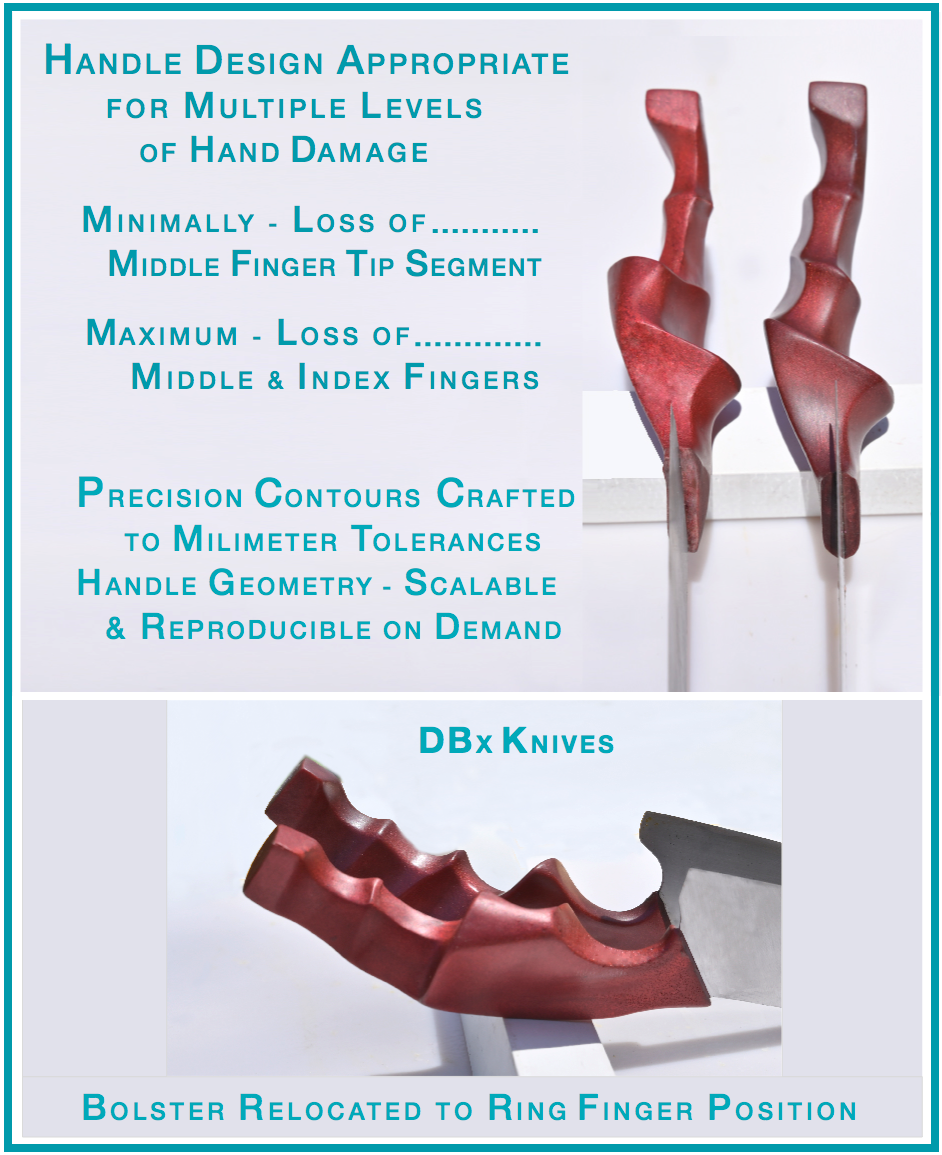
Asymmetrical handle corrections are permanent to match the new normal hand geometry and power output balance.
DBx custom handle geometry accommodates traumatic amputation across a clinical range . . .
From partial loss of a middle finger tip segment through complete loss of both middle and index fingers.
Precision Handle contours are crafted to millimeter tolerances.
Handle geometry is scalable and reproducible on demand from original Designs and tooling . . .
confirmation that a solution built for one patient is available for the next.
Hand Optimized geometry
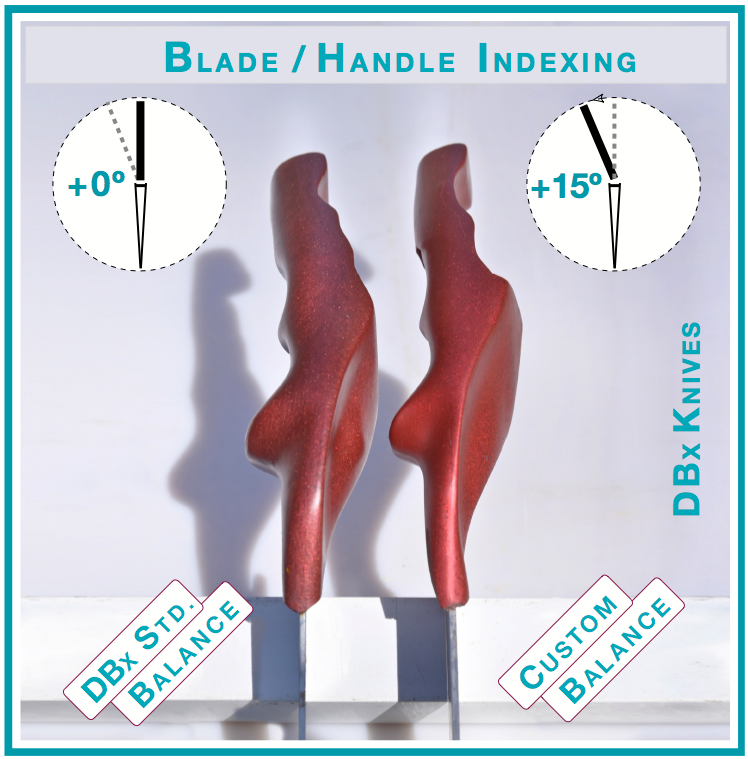
Standard fitted DBx handle geometry - in coordination with the hand, balances down pressure over the cutting edge at 0 degrees.
Custom fitted handle geometry is optimized to maximize accumulation of grip strength available in a hand which is structurally damaged.
Custom fitted handles are indexed to Accumulate and Balance down force input over the cutting edge for people with hand damage .
Input forces for patients with altered Hand Anatomy, resulting in a thumb-dominant grip Balance, often require 15 degrees of handle Indexing.
Patients with nerve damage and/or compromised mechanics in the: Hand, wrist and arm will also benefit from handle indexing.
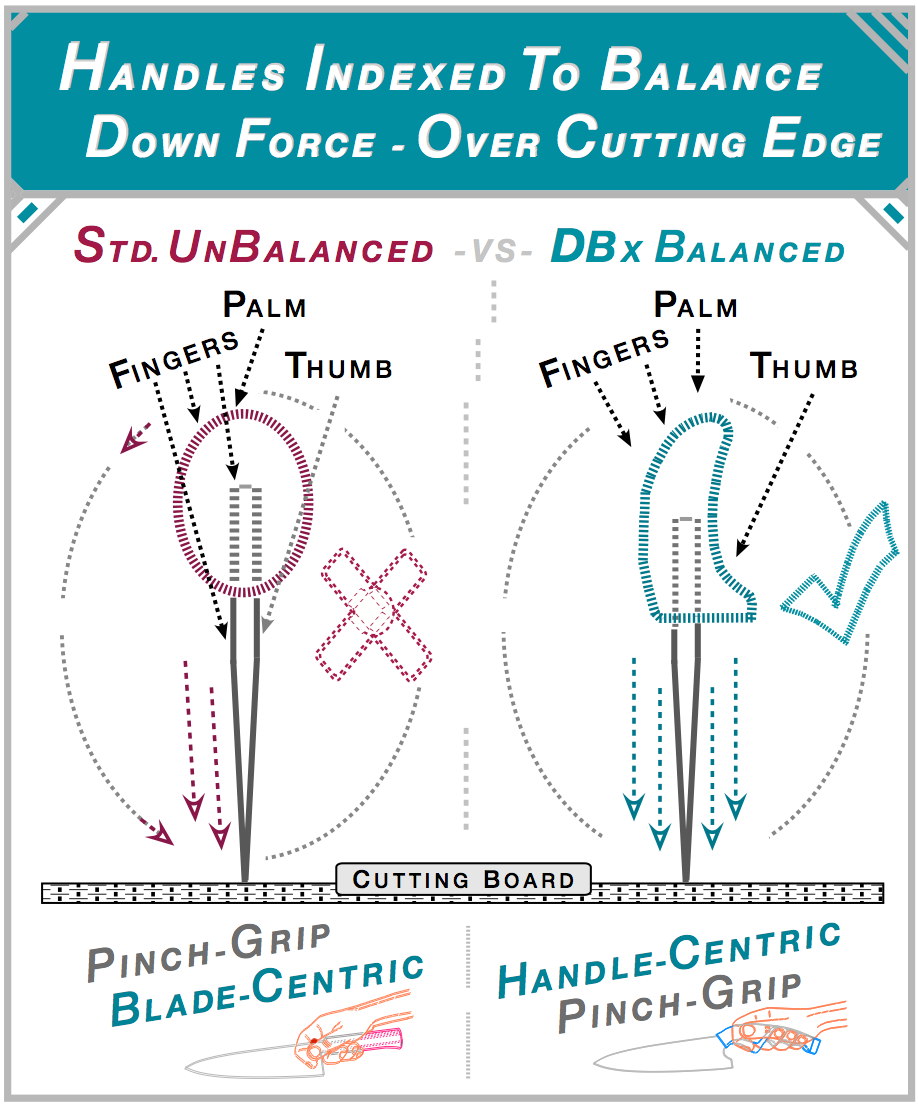
Standard blade centric pinch grip used in conjunction with traditional handles, accumulates input forces offset to the cutting edge.
unbalanced downforce vectors become unsafe rotational force vectors requiring continuous active stabilization.
DBx handles are designed to Coordinate and accumulate forces from the subsystems And substructure into the blade.
Asymmetrical DBx handles: Coordinate, Accumulate & distribute these symmetrically balanced down forces over & into the cutting edge.
This eliminates the compensatory stabilization demand that drives cumulative injury in healthy and compromised hand anatomy.

DBx makes hand optimized handles to preserve the health of our hands.
DBx Knives are crafted with fitted handles, 14 left-hand and 14 right-hand specific standard handle sizes.
Sized from 72mm to 96mm in 2mm increments to cover 96% of the population.
Custom Handle Geometry Extends This Range To Accommodate Hand Anatomy Outside Standard Parameters.
Handle Geometry is engineered to mirror the musculoskeletal structures & protect the neuro-vascular systems of the hand.
Passive fit geometry eliminates active stabilization demands and associated injuries entirely.
DBx does not make ambidextrous handles.
The patients documented below did not adapt to their knives.
Their knives were built to accommodate them.
Engineered To Mirror - The Musculoskeletal Structure Of Your Hand
Force Balance . . .
Eliminating Unsafe Rotational Force
Vectors
Documented Patient Outcomes
The Clinical Evidence
The outcomes documented below are not comfort claims or consumer testimonials
They are the direct biological consequences of resolving the fundamental mechanical
Failures That Traditional handle design has ignored . . .
documented by the patients themselves, most on video, under real Culinary conditions.
Every outcome listed represents a specific clinical population.
Every intervention listed is a reproducible design solution,
not a one-time custom fabrication.
Cathy. . .
Condition: Essential Tremors, Neurological grip instability, referred arm pain during extended use.
Intervention: Custom fitted 78mm right-hand DBx Santoku Chef Knife.
Outcome: Elimination of hand soreness & referred arm pain, full kitchen function restored
Denise. . .
Condition: Advanced arthritis reduced grip strength, limited joint flexibility, chronic pain.
Intervention: 76mm handle, mirrors compromised Hand Anatomy.
Outcome: Pain-free food preparation restored, full kitchen navigation returned.
Jay . . .
Condition: Occupational RSI — professional chef, decades of cumulative damage, requiring periodic medical intervention.
Intervention: Custom fitted - 88mm RH handle - DBx Chef Knife.
Outcome: Only knife usable without Pain, reduced Swelling & reliance on periodic medical interventions.
Anna . . .
Condition: Occupational RSI — USDA meat inspector, bilateral hand fatigue, career-threatening progression.
Intervention: Custom fitted - right and left-hand DBx tools — RH sheepsfoot Knife & LH Meat hook.
Outcome: Career preserved — bilateral custom accommodation for Dual asymmetrical professional task demands.
Darryl . . .
Condition: Traumatic amputation — loss of index and middle fingers, standard handle geometry non-functional.
Intervention: Custom Indexed handle design — bolster repositioned, Handle contours altered to Accommodate Migration of Structural anatomy.
Outcome: Full culinary function restored — Handle design Accommodates Various levels of Amputation, Multiple Culinary knives replicated from original handle tooling, confirming repeatability.
Nancy. . .
Condition: No injury or medical condition — yoga teacher, high body awareness, performance-oriented user.
Intervention: Custom fitted - 78mm right-hand - DBx Compact Chef Knife.
Outcome: Measurable comfort improvement over standard handles — confirms passive fit benefit extends to uncompromised anatomy.
Each outcome documented by the patient.
Most on video Full Reviews Available →
For Clinical Professionals . . .
PATIENT REFERRAL & CLINICAL CONSULTATION
DBx Knives works directly with hand surgeons, occupational therapists and rehabilitation specialists . . .
to develop custom fitted knife solutions for patients with specific clinical conditions.
Every intervention begins with a hand measurement consultation.
Every design solution is documented, reproducible and available for subsequent patients with similar anatomy.
Contact us to discuss your patient's specific requirements →
For Patients & Home Cooks
GET MEASURED FOR YOUR CUSTOM FITTED KNIFE
Your hand is anatomically unique. Your knife should reflect that.
DBx custom fitting begins with a simple hand measurement — right hand, left hand, or both.
From that measurement we build a handle geometry that coordinates . . .
every cooperative group your hand has available, eliminates compensatory stabilization demands,
These handles protect the neuro-vascular and musculoskeletal systems you depend on every day.
For The Clinical Record
ABx PERFORMANCE TESTING DOCUMENTATION
Every claim on this page is backed by instrumented ABx performance testing conducted on high density foods under real-world cutting conditions.
Independent peer-reviewed research from the New Zealand meat cutting industry confirms the exponential relationship between grip force reduction and injury risk . . .
consistent with our testing conclusions. Full testing methodology and performance data available on request.